
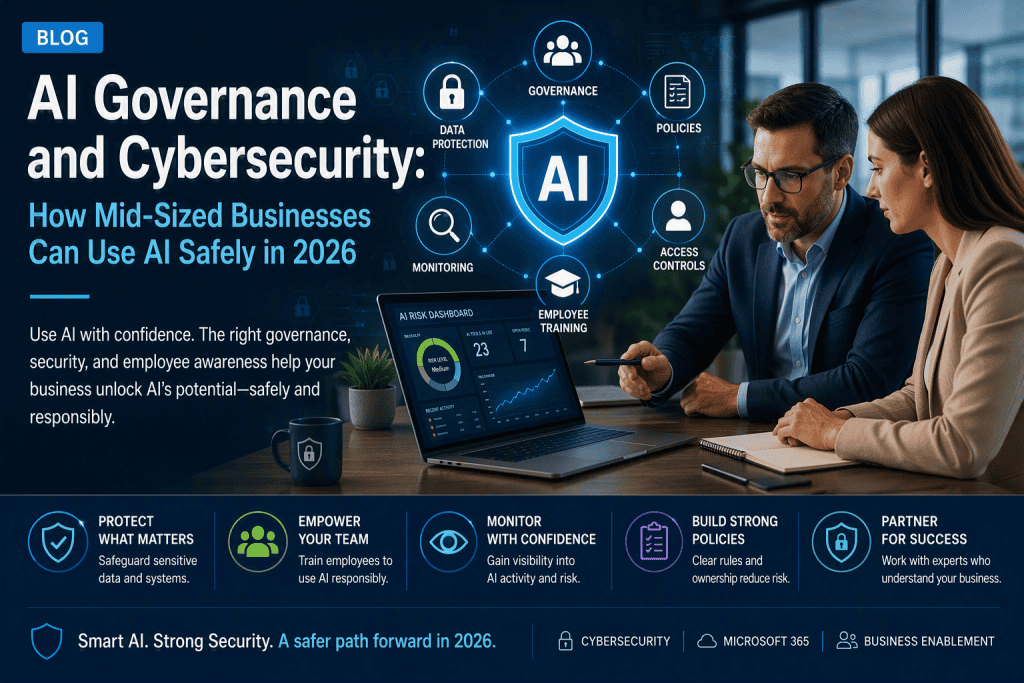
AI governance and cybersecurity help mid-sized businesses use AI safely by setting clear rules for approved tools, protecting sensitive data, monitoring AI activity, training employees, and reviewing vendor risk. A practical AI security plan should include ownership, policies, access controls, Microsoft 365 protections, employee awareness, and regular review.
The best way for a mid-sized business to manage AI risk is to identify where AI is being used, decide which tools are approved, protect sensitive data, train employees on safe AI use, and monitor AI activity over time.
AI governance and cybersecurity now go hand in hand. AI is already showing up in most mid-sized businesses, whether teams are using it for customer service, reporting, document creation, or to automate everyday work. That can create real business value, but only if it is managed properly. The problem is that many companies are moving faster with AI than they are with security, policies, and oversight. Arnet helps businesses put the right guardrails in place so AI can support growth without creating unnecessary cyber risk.
Why AI Governance and Cybersecurity Matter for Mid-Sized Businesses
Mid-sized businesses are in a tough spot. They face many of the same cyber risks as larger companies, but they often do not have the same internal resources, security staff, or time to manage every new risk AI introduces.
AI adoption is accelerating quickly across the middle market, but governance and cybersecurity are not always keeping up. That creates a dangerous gap: leaders may feel confident about their security while hidden risks are growing in the background.
That gap between confidence and readiness is where problems start. The goal is not to slow AI down. The goal is to make sure your business can use it safely, responsibly, and with a clear understanding of the risks.
What AI Governance Means for Cybersecurity
AI governance is simply the set of rules, responsibilities, and controls your organization uses to decide how AI can be used. From a cybersecurity standpoint, it helps make sure AI tools are not exposing sensitive information, making decisions no one can explain, or creating new ways for attackers to get into your systems.
Without governance, employees may start using unapproved AI tools on their own. Sensitive company or client data can be copied into systems your IT team does not control. AI tools can also be manipulated through bad prompts or connected to business systems without enough oversight.
Good governance gives your business a practical way to say yes to AI while still protecting your data, users, clients, and reputation.
Quick Answer: How Can Businesses Use AI Safely?
Businesses can use AI safely by creating clear rules for approved tools, limiting what data employees can enter into AI systems, reviewing vendor security, monitoring AI activity, and training employees on practical AI risks. The goal is not to stop using AI. The goal is to make AI safe, visible, and aligned with business needs.
Five AI Security Risks Businesses Should Watch
The biggest AI security risks include data exposure, unapproved AI tools, risky prompts, weak access controls, limited visibility, vendor risk, and employees using AI without clear guidance. These are five areas every business should understand.
1. Misuse of AI Tools and Risky Prompts
Even approved users can accidentally use AI in risky ways. A poorly written prompt, the wrong data, or a malicious request can cause an AI system to reveal information or take an action it should not. Businesses need controls that look beyond who has access and also consider what the tool is being asked to do.
2. Limited Visibility Into AI Activity
AI tools can move fast. They may collect information, trigger workflows, create content, or interact with other systems before a person has time to review every action. That makes visibility important. Your team needs to know what AI is doing, where data is going, and when something does not look right.
3. Weak Security Around AI Projects
Security issues often begin before an AI tool is ever launched. Poor permissions, weak configurations, or untested code can create risk early in the process. AI projects should be reviewed with security in mind from the start, not after they are already in use.
4. Vendor and AI Supply Chain Risk
Most businesses use AI tools built by outside vendors. That means your security depends partly on how those vendors manage data, models, permissions, and updates. Before adopting an AI tool, it is important to understand where your data goes and how it is protected.
5. Employee Readiness and Safe AI Use
Technology alone will not solve AI risk. Your people need to know what is allowed, what is risky, and when to raise a concern. Clear policies, employee training, and regular review help turn AI security from a technical project into a business-wide habit.
How to Build a Practical AI Governance Plan
A practical AI governance plan should define who owns AI decisions, which tools are approved, what data can be used, how risks are reviewed, and how employees should report concerns.
Bring the Right People Together
AI decisions should not sit with one person or one department. IT, leadership, operations, compliance, and security all need a voice. This group should decide which AI tools are approved, what data can be used, and how risk will be reviewed.
Just as important, someone needs to own the process. Who approves new AI tools? Who reviews incidents? Who reports AI-related risk to leadership? If no one owns it, it will get missed.
Know Which AI Tools Are Already Being Used
Create an AI Inventory and Risk Assessment Process
You cannot protect what you do not know exists. Start by identifying the AI tools already being used across the business, including tools employees may have adopted without formal approval. Then look at what data each tool touches and what business process it supports.
This does not need to be overly complex. A simple inventory of tools, users, data types, vendors, and risk level is a strong place to start.
Create Clear AI Use Policies
Your team should know which AI tools are approved, what information can be entered into them, how AI-generated output should be reviewed, and what to do if something seems wrong. The policy should be simple enough that employees will actually use it.
Long, heavy legal documents often get ignored. Plain-language guidance, real examples, and clear do’s and don’ts are usually more effective.
For higher-risk uses, require human review before AI can make decisions, access sensitive data, or take action that could affect clients, finances, operations, or compliance. Your business should also have a clear way to shut down or pause an AI tool if it behaves unexpectedly.
Build AI Security Awareness Across the Business. Even the best tools and policies can fail if employees do not understand the risk. AI security must be part of everyday awareness, not just an IT topic.
Training Employees in Safe AI Use
Train employees in the basics: do not paste sensitive data into unapproved tools, be cautious with AI-generated emails or attachments, and report anything that seems unusual. The training should be short, practical, and tied to the way people actually work.
Use real examples. Show what risky AI use looks like. Give employees simple rules they can remember. The goal is not to scare people away from AI. The goal is to help them use it responsibly.
Creating a Culture of Responsible AI
Responsible AI should feel like a shared business priority. Encourage employees to ask questions, raise concerns, and challenge risky use. When people feel comfortable speaking up, your business is much more likely to catch problems early.
Practical Steps to Improve AI Governance and Cybersecurity
The best way to approach AI security is to start small, get organized, and build from there. You do not need to solve everything at once.
Step 1: Assess Your Current AI Security Risk
Start by understanding where AI is already being used, what data is involved, and where your biggest gaps are. This gives leadership a clear picture of current risk before new AI projects are added.
Arnet can help businesses map their current AI use, identify security gaps, and create a practical plan that supports business goals without putting data at unnecessary risk.
Step 2: Prioritize AI Risks Based on Business Impact
Not every AI risk carries the same weight. Focus first on tools that touch sensitive data, connect to important systems, support client-facing work, or influence business decisions.
Step 3: Build AI Governance Foundations
Put the basics in place before AI use expands further. That includes ownership, approved tools, data rules, review processes, and a clear path for employees to ask questions.
Step 4: Implement AI Security Controls
Add the right technical protections around the AI tools your business depends on. This may include access controls, monitoring, alerting, vendor reviews, and limits on what data can be used.
Step 5: Train Employees and Communicate Clearly
Make sure employees understand the rules and the reasons behind them. People are more likely to follow security guidance when it is clear, practical, and connected to real business risk.
Step 6: Monitor AI Use and Improve Over Time
AI security is not a one-time project. As your business uses AI in new ways, your policies, tools, and training need to evolve with it. Regular reviews help keep AI useful and safe over time.
Where a Managed IT Partner Can Help With AI Security
Many mid-sized businesses do not have the internal time or expertise to build an AI security program on their own. That is where the right IT partner can make a real difference.
How Arnet Supports AI Governance and Cybersecurity
Arnet helps businesses take a practical approach to AI and cybersecurity. That can include reviewing current AI use, identifying gaps, building clear policies, strengthening Microsoft 365 security, monitoring for suspicious activity, and helping leadership make informed decisions about risk.
Choosing the Right AI Security Partner
Look for a partner who understands both cybersecurity and how businesses actually want to use AI. The right partner should help you move forward safely, not bury your team in complexity or slow progress with unnecessary roadblocks.
Frequently Asked Questions About AI Governance and Cybersecurity
What is AI governance?
AI governance is the set of rules, responsibilities, and controls a business uses to decide how AI tools can be used. It helps protect sensitive data, reduce risk, and make sure AI supports the business safely and responsibly.
How does AI create cybersecurity risk?
AI can create cybersecurity risk when employees use unapproved tools, enter sensitive company data into public systems, connect AI tools to business applications without review, or rely on AI-generated output without human oversight.
What should be included in an AI use policy?
An AI use policy should explain which tools are approved, what information employees can and cannot enter into AI tools, when human review is required, how AI-generated content should be checked, and who to contact with questions or concerns.
Why does Microsoft 365 security matter for AI?
Microsoft 365 security matters because many businesses store email, documents, identities, and collaboration data in Microsoft 365. If AI tools connect to that environment, strong identity protection, access controls, monitoring, and data policies become even more important.
How can Arnet help with AI governance and cybersecurity?
Arnet helps mid-sized businesses review how AI is being used, identify security gaps, strengthen Microsoft 365 protections, create clear AI use policies, train employees, and build a practical plan for safer AI adoption.