
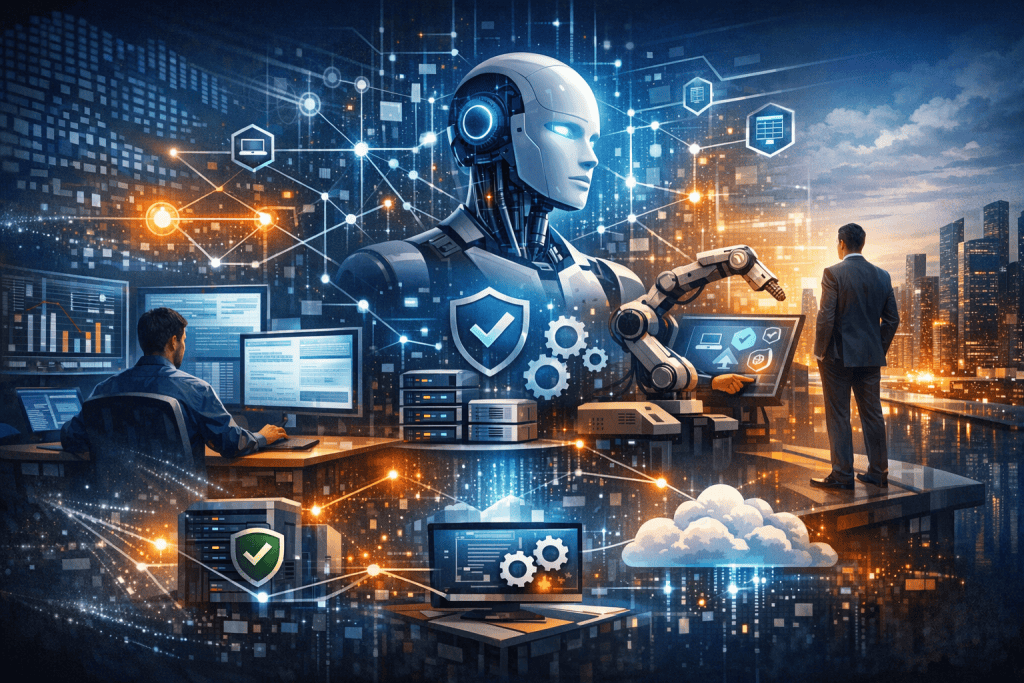
We’ve spent decades helping organizations manage, secure, and evolve their IT environments. Over that time, one thing has remained constant: IT complexity always grows faster than the teams managing it. Agentic AI is our answer to that imbalance. This isn’t a buzzword for us. It’s a fundamental shift in how IT work gets done—and how businesses should think about the role IT plays in their success.
Why We Believe Agentic AI Is Inevitable
Traditional IT management is built around reaction.
- Something breaks.
- A user reports it.
- A ticket is created.
- A human intervenes.
That model doesn’t scale anymore. Modern IT environments include thousands of devices, countless applications, constant security threats, and a workforce that expects immediate resolution. Even the best IT teams can’t manually keep up. Agentic AI changes the equation by introducing systems that can observe what’s happening, reason about it, and take action automatically, within boundaries defined by IT. These systems are autonomous, context‑aware, and capable of learning over time. From our perspective, this isn’t about replacing people. It’s about removing humans from work they were never meant to do at scale.
What “Agentic” Really Means to Us
At Arnet, we define Agentic AI very simply: Software agents that can act on behalf of IT teams—without waiting for constant instruction.
These agents can:
- Monitor systems continuously
- Identify issues before users notice
- Execute multi‑step workflows
- Escalate only when human judgment is truly needed
This is a major step beyond traditional automation. Scripts follow rules. Agentic systems make decisions. That distinction is what unlocks real change.
How Agentic AI Redefines IT Management
From Tickets to Outcome
We don’t believe the future of IT is about closing tickets faster. We believe the future of IT is about eliminating tickets altogether.
Agentic AI allows IT environments to self‑correct:
- A device drifts from compliance → it’s fixed automatically
- A configuration change causes instability → it’s rolled back
- A common user issue appears → it’s resolved before a ticket is submitted
When this happens, IT stops measuring success by volume of work and starts measuring success by problems that never occurred.
From Reactive to Predictive
One of the biggest shifts we see with Agentic AI is timing. Instead of reacting after failure, agentic systems operate ahead of failure. They recognize patterns humans don’t have time to watch for and act before issues escalate. This is especially powerful when paired with modern, cloud‑based management platforms where consistency and visibility already exist. Agentic AI adds reasoning and decision‑making on top of that foundation.
From IT Support to Business Enablement
As agents take over repetitive, low‑value work, human IT professionals move up the stack.
Their role becomes:
- Designing guardrails
- Defining policy and intent
- Reviewing exceptions
- Aligning technology with business outcomes
In other words, IT becomes less about fixing and more about guiding. From our point of view, this is how IT finally earns a permanent seat at the strategy table.
A Hard Truth We’re Willing to Say Out Loud
Agentic AI will replace some traditional IT roles. Ignoring that doesn’t help anyone.
But it will also create a stronger demand for:
- System thinkers
- Architects
- Security‑minded leaders
- People who understand both technology and business
Organizations that prepare their teams for this shift will thrive. Those that cling to old models will struggle to keep up—regardless of how talented their people are.
How We’re Guiding Clients Forward
We don’t believe in flipping a switch and handing control to AI overnight.
The road to Agentic AI starts with fundamentals:
- Clean, reliable data
- Standardized configurations
- Simplified Environments
- Clear ownership and accountability
Only then do agentic systems make sense.
Our role is to help organizations build the right foundation, introduce autonomy gradually, and maintain human oversight where it matters most.
Our Bottom Line
Agentic AI is not a trend. It’s not a feature. And it’s not optional. It’s the next operating model for IT. Organizations that embrace it will move faster, operate more securely, and free their people to focus on what actually drives value. Organizations that don’t will continue fighting complexity with human effort alone—and that’s a losing battle. We’re committed to helping our clients navigate this shift responsibly, practically, and with confidence.
Because the future of IT isn’t about working harder. It’s about building systems that work for you.